
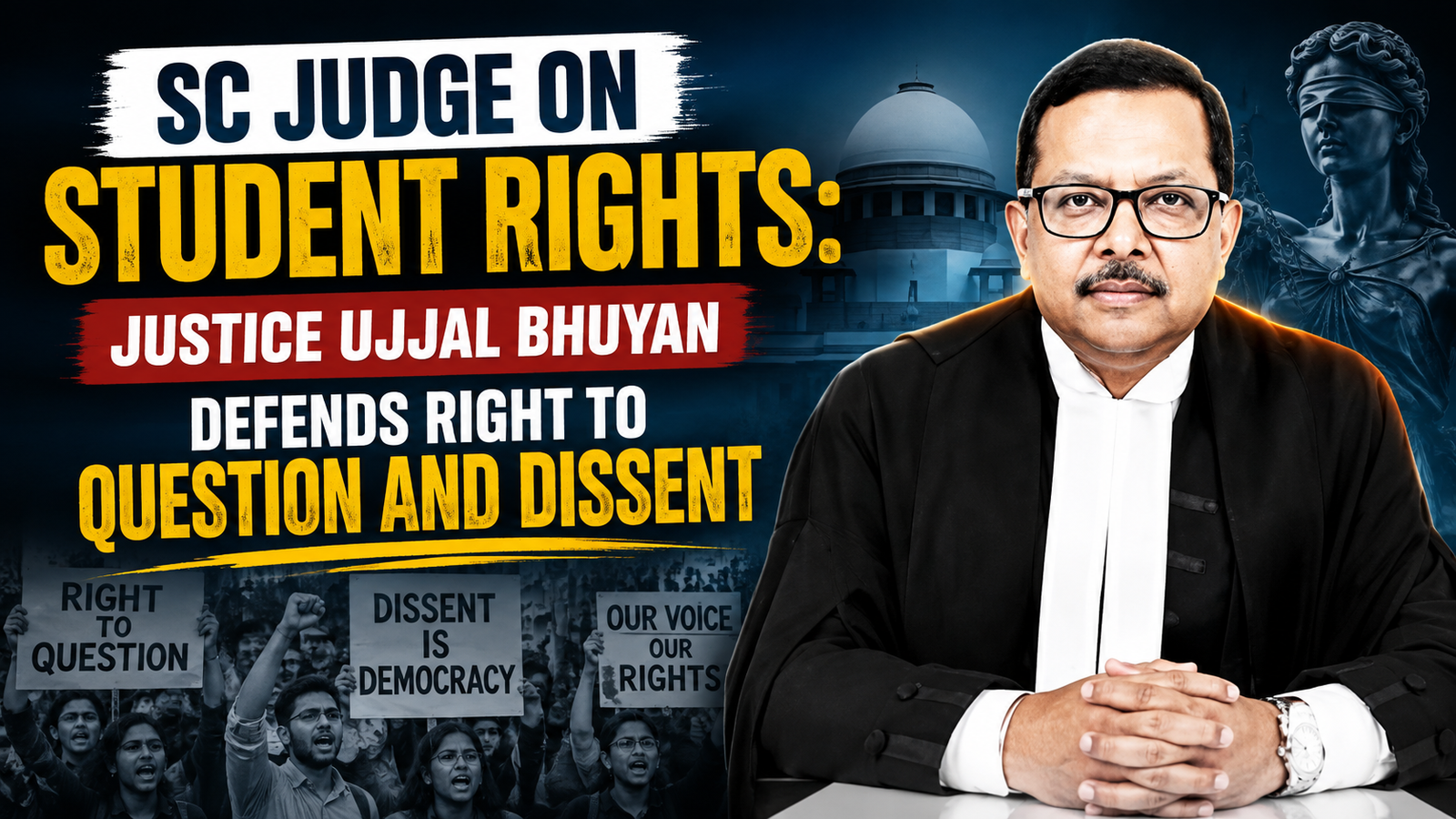
SC Judge on Student Rights: Justice Ujjal Bhuyan Defends Right to Question and Dissent
SC Judge on Student Rights has become an important topic after Supreme Court Justice Ujjal Bhuyan said that threatening students with punitive action for asking questions or expressing dissenting views is unconstitutional.
His remarks have renewed discussion around freedom of expression on university campuses and the responsibility of educational institutions to create an environment where students can question, debate and express different opinions.
The comments are particularly significant because universities are expected to encourage critical thinking rather than discourage students from challenging ideas or authority.
Justice Ujjal Bhuyan’s Remarks on Student Rights
Justice Ujjal Bhuyan emphasised that students should not be threatened with punitive action simply because they ask questions or express views that differ from those in authority.
According to the observation, using institutional power to intimidate students for expressing dissent can amount to a misuse of authority.
The remarks place the issue within the broader constitutional framework of freedom of expression and the rights of students within educational institutions.
Why the Right to Question Matters
Questioning is an essential part of education.
Students are expected to examine ideas, challenge assumptions and seek explanations rather than simply accept everything presented to them.
A university environment where students fear punishment for asking difficult questions can have a negative impact on academic freedom and intellectual development.
The comments by Justice Bhuyan underline the importance of allowing students to engage in open discussions while maintaining reasonable institutional rules.
Right to Dissent and Freedom of Expression
Dissent does not necessarily mean disagreement for its own sake.
In an academic environment, dissent can involve presenting an alternative interpretation, challenging an established position or raising concerns about a decision.
The ability to express such views is closely connected to the broader principle of freedom of expression.
Justice Bhuyan’s remarks highlight that institutional authority should not automatically be used to silence opinions simply because they are unpopular or critical.
Universities and Their Powers
Universities have legitimate responsibilities to maintain discipline, protect students and staff, and ensure that academic activities function properly.
However, disciplinary powers also come with responsibilities.
Institutional rules should not be used as a tool to intimidate students who engage in legitimate questioning or express differing views.
The distinction between genuine misconduct and legitimate dissent is therefore important.
What Does Misuse of Power Mean?
When an institution threatens punitive action without a legitimate disciplinary basis, its authority can potentially be misused.
Students may become reluctant to speak openly if they believe criticism could lead to punishment.
This can create an atmosphere where students avoid discussions on sensitive or controversial issues.
The observations attributed to Justice Bhuyan highlight why institutional authority must be exercised carefully and within constitutional boundaries.
Academic Freedom and Student Life
Academic freedom is an important part of higher education.
Universities are places where students encounter different ideas, perspectives and arguments.
Debates can sometimes become uncomfortable, particularly when students question established positions.
However, disagreement itself should not automatically be treated as misconduct.
A healthy academic environment allows students to disagree while also expecting them to follow reasonable standards of conduct.
Why the Remarks Matter for Students
For students, the remarks offer an important reminder that education is not simply about memorising information.
Critical thinking, discussion and questioning are fundamental aspects of learning.
Students may sometimes challenge teachers, administrators or institutional decisions.
The ability to do so responsibly is an important part of developing independent thought.
At the same time, freedom of expression does not remove the need to follow lawful rules or respect the rights of others.
Balancing Discipline and Freedom
Universities need to maintain a balance between institutional discipline and student freedom.
Rules are necessary to prevent harassment, violence, disruption and other forms of genuine misconduct.
But disciplinary mechanisms should be applied based on actual violations rather than simply because a student has expressed an unpopular opinion.
This balance is essential for maintaining both a safe campus and a healthy academic environment.
Broader Constitutional Context
The issue of student dissent is connected to India’s constitutional protections for freedom of speech and expression.
While constitutional freedoms are subject to lawful restrictions, the existence of institutional authority does not mean that universities have unlimited power over students’ expression.
The observations by Justice Bhuyan bring attention to this important distinction.
They also raise broader questions about how educational institutions should handle criticism and disagreement.
What Universities Can Learn
Universities can use such discussions as an opportunity to review how complaints and disciplinary proceedings involving students are handled.
Clear rules, transparent procedures and opportunities for students to present their side can help prevent unnecessary disputes.
Institutions can also encourage structured debates and forums where students can raise concerns without fear of arbitrary punishment.
Such approaches can strengthen trust between students and university administrations.
Why Student Dissent Can Strengthen Institutions
Dissent can sometimes help institutions identify problems that might otherwise remain unnoticed.
Students may raise concerns about policies, academic practices or administrative decisions.
Listening to those concerns does not mean that every criticism must be accepted.
Instead, it creates an opportunity for institutions to explain their decisions, correct genuine problems and improve communication.
A university that allows respectful disagreement can ultimately develop a stronger culture of accountability.
The Importance of Responsible Expression
While students have important rights, expression also comes with responsibilities.
Students should express their views without resorting to threats, violence, harassment or unlawful conduct.
Universities can legitimately intervene when behaviour crosses established legal or disciplinary boundaries.
The central issue is that asking questions or expressing a dissenting view by itself should not be treated as grounds for punitive action.
SC Judge on Student Rights: Key Takeaway
The latest discussion around SC Judge on Student Rights highlights the importance of protecting students who ask questions and express dissenting opinions.
Justice Ujjal Bhuyan’s remarks emphasise that threatening students with punitive action merely for questioning or expressing disagreement can be unconstitutional and may represent a misuse of institutional power.
The issue is ultimately about maintaining the right balance between university discipline and freedom of expression.
Educational institutions have a responsibility to maintain order, but they also have an important role in encouraging debate, critical thinking and independent thought.
Frequently Asked Questions (FAQs)
1. What did Justice Ujjal Bhuyan say about student rights?
Justice Ujjal Bhuyan stated that threatening students with punitive action for asking questions or expressing dissenting views is unconstitutional and can amount to a misuse of university power.
2. Why is the right to question important for students?
Questioning allows students to develop critical thinking, examine different ideas and understand subjects more deeply. It is an important part of the educational process.
3. What is student dissent?
Student dissent generally refers to expressing disagreement with an idea, decision, policy or position, particularly within an academic or institutional setting.
4. Can universities take disciplinary action against students?
Universities can take disciplinary action for genuine violations of applicable rules and laws. However, legitimate questioning or expression of a dissenting opinion should not automatically be treated as misconduct.
5. Does freedom of expression mean students can say anything?
No. Freedom of expression is subject to lawful restrictions and does not protect unlawful conduct such as threats, violence or harassment.
6. Why are Justice Ujjal Bhuyan’s remarks significant?
The remarks highlight the need for universities to exercise disciplinary powers responsibly while respecting constitutional principles and students’ ability to question and express views.
7. What is academic freedom?
Academic freedom broadly refers to the ability of students and academics to pursue learning, research, discussion and debate without improper interference or intimidation.
8. How can universities protect both discipline and student rights?
Universities can maintain clear rules, transparent disciplinary procedures and fair opportunities for students to explain their position while taking action against genuine misconduct.
9. Can dissent benefit universities?
Yes. Constructive dissent can help institutions identify problems, encourage debate and improve policies and decision-making.
10. What is the key message for students?
Students should be able to ask questions and express disagreement responsibly, while universities should ensure that institutional authority is not used arbitrarily to suppress legitimate expression.

