
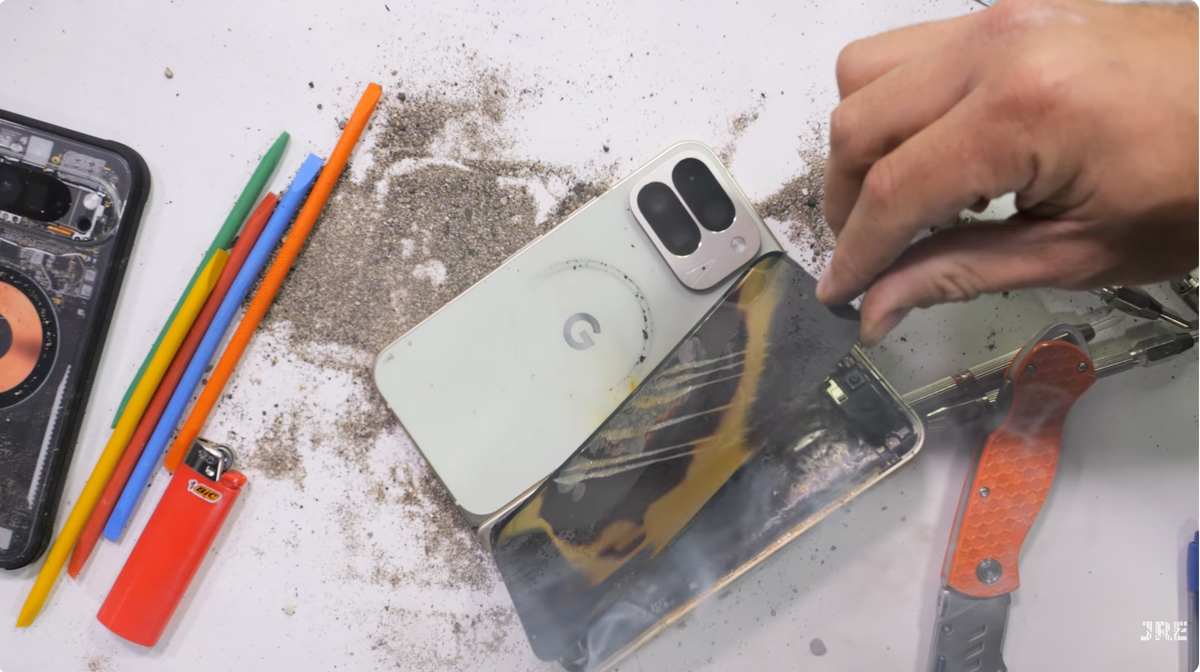
The highly awaited Google Pixel 10 Pro Fold created a storm online recently—not for its cutting-edge AI camera or stunning display—but because of a shocking incident during its durability test. A viral video showed the phone exploding during a bend test, raising serious questions about its safety and design durability. Here’s everything you need to know about what happened, why it might have occurred, and what it means for Google’s foldable future.
The Incident That Shook Tech Fans
Tech reviewers and durability testers often perform bend, scratch, and burn tests on flagship smartphones to examine their build quality. When one well-known YouTube channel attempted the Pixel 10 Pro Fold bend test, the results turned startling.
Instead of flexing slightly under pressure as expected, the Pixel 10 Pro Fold reportedly emitted smoke and burst at the hinge after slight bending. Within seconds, flames appeared near the folding section, shocking both the tester and viewers watching live.
Millions of users watched the clip across social media platforms, sparking a flood of reactions questioning whether Google’s latest foldable flagship was truly ready for the market.
What Makes the Pixel 10 Pro Fold Special
Before the controversy, the Google Pixel 10 Pro Fold was being hailed as Google’s most powerful and elegant foldable phone yet. It was designed to compete directly with Samsung’s Galaxy Z Fold 6 and OnePlus Open 2. Some of its key highlights included:
Tensor G4 processor with enhanced AI features
A 120Hz LTPO AMOLED foldable display
Improved titanium hinge design promising better durability
Advanced camera system with Google’s signature computational photography
Android 15 Fold edition optimized for multitasking
With such high-end specifications, fans expected a flawless experience. That’s what made this unexpected incident even more surprising.
The Moment of Explosion Explained
According to initial observations, the explosion happened during the full bend test, where testers apply equal pressure to see if the foldable screen or hinge flexes naturally. The Pixel 10 Pro Fold’s hinge area seemed to experience a sudden internal short-circuit, possibly due to battery compression when the flexible body was forced beyond a certain degree.
Experts noted that foldable smartphones house batteries split between two panels. If the frame bends deeper than intended, the battery layers can pierce or squeeze, causing leakage or even combustion—a phenomenon seen in earlier prototypes from various brands.
Expert Opinions and Safety Concerns
Following the viral explosion, several tech analysts and engineers shared their thoughts:
Battery Placement Issue: Some specialists think that the phone’s internal battery distribution near the hinge played a major role. Any stress beyond safe limits could damage the protective barrier.
Thermal Management: The thin design of modern foldables often leaves little room for proper heat dissipation.
Manufacturing Tolerance: Every smartphone has a margin for mechanical errors. If that tolerance is too tight, even minor shape distortion can trigger serious reactions.
While Google has not officially released an extensive statement, early sources from within the company have reportedly acknowledged that an internal investigation is underway.
Google’s Response and Action Plan
Shortly after the incident went viral, Google’s spokesperson issued a short note acknowledging the event. The company stated that the case was “under detailed review” and assured users that safety remains its top priority.
Although no official recall has been announced yet, Google is reportedly analyzing test results from the production batch to ensure there are no widespread defects. The firm might also release a software patch to monitor thermal and battery conditions more precisely.
Insiders suggest that Google may tighten its quality control testing procedures before shipping units globally, especially to markets like India and Europe, where foldable adoption is growing rapidly.
How the Pixel 10 Pro Fold Compares to Rivals
The foldable phone segment is getting crowded, and every small issue gets magnified. Let’s see how the Google Pixel 10 Pro Fold fares against some of its top rivals in terms of durability concerns:
| Feature | Google Pixel 10 Pro Fold | Samsung Galaxy Z Fold 6 | OnePlus Open 2 |
|---|---|---|---|
| Hinge Strength | Reported failure in bend test | Proven durability | Reinforced alloy construction |
| Battery Safety | Under investigation after explosion | Stable with tested safety margin | Reliable with thermal cooling |
| Foldable Design | Thinner hinge design | Bulkier but stronger | Balanced durability |
| Market Reputation | Affected by explosion event | Strong reputation | Rapidly improving |
Lessons Learned from the Pixel 10 Pro Fold’s Explosion
The incident is a reminder that foldable phone technology still has risks. Even with advanced engineering, the thin foldable form factor creates pressure zones that can challenge safety standards.
Here are the key takeaways for both consumers and manufacturers:
Foldable devices must maintain a safer hinge-to-battery distance.
Manufacturers should implement real-life durability simulations before launches.
Consumers should handle foldables carefully and avoid extreme bends.
Thorough software integration for thermal alerts can prevent overheating-related issues.
Safety testing transparency can rebuild brand trust after such events.
For users, the takeaway is simple—foldable phones are innovative but still evolving, and handling them with extra care is always wise.
Can Google Recover from This?
Despite the unexpected explosion, Google’s reputation as a tech innovator remains strong. The Pixel ecosystem—Smartphones, Watches, and AI services—has built credibility worldwide. Most consumers understand that early production issues can happen with newly engineered technology.
If Google addresses the cause transparently, enhances safety, and replaces affected units quickly, the Pixel 10 Pro Fold can still regain user confidence. The demand for foldable devices is rising, and users want options beyond Samsung and OnePlus.
Moreover, if future updates or revisions of the model demonstrate better thermal control and hinge strength, many may forgive this one-off failure.
The Future of Foldable Smartphones
Incidents like this often serve as turning points in the smartphone industry. Just as earlier battery explosions led to advanced safety standards, this case could push manufacturers toward more reliable foldable tech.
We may soon see foldables featuring:
Solid-state batteries resistant to pressure damage
Carbon-fiber reinforced hinges for extra flexibility
Smart AI-driven temperature regulation frameworks
Enhanced material layering preventing internal punctures
Such innovations will not only make foldables safer but also ensure more consistent performance over years of use.
Conclusion
The Google Pixel 10 Pro Fold explosion during the bend test may have shocked fans, but it highlights the importance of safety testing and responsible innovation. As technology continues to evolve, every shortcoming becomes an opportunity for manufacturers to build something stronger and safer.
Google’s quick response and willingness to investigate show its commitment to improvement. For consumers, the incident serves as a reminder that foldable phones combine incredible innovation with complex engineering—one that still needs refinement.
If handled with transparency and precision, the Pixel 10 Pro Fold could mark not a failure, but the next step forward in foldable phone evolution.

