
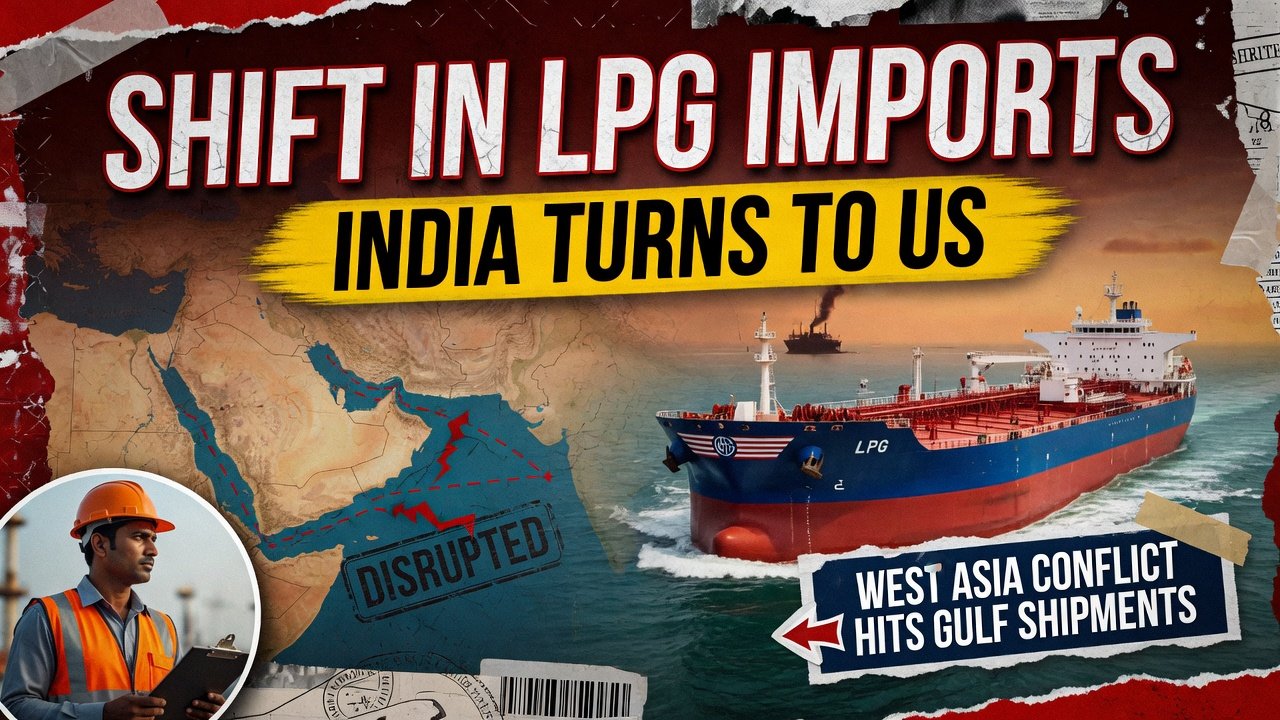
Shift in LPG Imports: India Turns to US Supplies as West Asia Conflict Disrupts Gulf Shipments
The Shift in LPG Imports has become a significant development in India’s energy market as geopolitical tensions in West Asia disrupt traditional supply routes from Gulf countries.
Over the past six months, India’s share of LPG imports from the United States has surged from 7.9% to 53%, highlighting a major change in the country’s sourcing strategy.
The shift comes as disruptions affecting major LPG-producing and exporting countries in the Gulf create uncertainty around supplies. India, one of the world’s largest LPG-consuming markets, has increasingly turned to US cargoes to maintain adequate supplies and protect domestic availability.
US Emerges as a Major LPG Supplier
The most striking aspect of the latest Shift in LPG Imports is the rapid increase in America’s contribution to India’s LPG supply.
US-origin LPG accounted for just 7.9% of India’s imports around six months ago. That share has now climbed to approximately 53%.
The change demonstrates how quickly global energy trade can adjust when traditional supply chains face disruption.
For India, the United States provides an alternative source of propane and butane, the primary components used in LPG.
West Asia Conflict Disrupts Gulf Supplies
The shift has been driven largely by the continuing geopolitical conflict in West Asia.
India has traditionally depended heavily on suppliers in the Gulf region for LPG. Countries such as Saudi Arabia, Qatar, the United Arab Emirates and Kuwait have historically played important roles in India’s LPG import basket.
Disruptions in the region can affect shipping schedules, freight costs, availability and the overall economics of importing LPG.
As uncertainty increased, Indian oil companies began looking for alternative sources that could provide reliable cargoes.
US suppliers emerged as an important option.
Why India Depends on Imported LPG
India’s LPG consumption has expanded substantially over the past decade.
The fuel is widely used by households for cooking and is also consumed by commercial establishments and various industries.
Government programmes aimed at expanding access to clean cooking fuel have also contributed to the country’s large LPG demand base.
Domestic production alone is not sufficient to meet the country’s requirements, making imports an essential part of India’s energy supply chain.
This dependence means that disruptions in major exporting regions can have a direct impact on India’s energy security.
US LPG Offers a Diversification Option
The increase in imports from the US provides India with an important diversification opportunity.
Rather than depending predominantly on one geographical region, Indian importers can source LPG from different parts of the global market.
The United States has become a major exporter of LPG due to its large-scale production of natural gas and associated liquids.
Its extensive export infrastructure, including terminals along the US Gulf Coast, allows American LPG cargoes to reach markets across Asia.
For Indian buyers, this creates another source of supply when Middle Eastern cargoes become difficult or expensive to secure.
From 7.9% to 53% in Six Months
The scale of the change is particularly notable.
A rise from 7.9% to 53% means that the US has moved from being a relatively small supplier to becoming the dominant source of India’s imported LPG in a short period.
Such a rapid change indicates that Indian energy companies are actively responding to changing global market conditions.
It also demonstrates the flexibility of international LPG markets, where cargoes can be redirected depending on pricing, freight availability and geopolitical developments.
Impact on India’s Energy Security
The latest import shift could strengthen India’s energy security by reducing its dependence on a single region.
Diversification can provide a buffer when supply from one group of countries becomes disrupted.
If Gulf shipments face delays or restrictions, US cargoes can potentially fill part of the gap.
However, longer shipping distances from the United States to India can also increase transportation costs and expose importers to changes in freight rates.
The overall benefit therefore depends on the relative cost and availability of cargoes from different sources.
What Does This Mean for LPG Consumers?
For Indian households, the most important question is whether the change in import patterns will affect LPG availability and prices.
The primary objective of increasing US imports is to maintain supply stability despite disruptions in West Asia.
If alternative supplies remain available at competitive prices, the diversification could help prevent shortages.
However, international LPG prices, shipping costs, currency movements and government pricing policies can all influence the final cost paid by consumers.
Therefore, a higher share of US imports does not automatically mean that domestic LPG prices will rise or fall by the same proportion.
Gulf Countries Remain Important
Despite the sharp increase in US imports, Gulf countries remain strategically important to India’s energy system.
The Middle East is geographically closer to India than the United States and has traditionally been a major source of LPG.
Long-established commercial relationships and existing shipping routes also make Gulf suppliers an important part of India’s import infrastructure.
The latest shift should therefore be viewed primarily as diversification rather than an immediate replacement of Gulf suppliers.
Once geopolitical conditions stabilize, the balance between US and Gulf-origin cargoes could change again.
Shipping Routes Become More Important
The conflict in West Asia has also highlighted the importance of maritime routes in global energy security.
LPG is transported primarily by specialized gas carriers, and disruptions affecting major shipping corridors can influence both availability and freight costs.
Longer routes from the US to India can increase voyage times, but they also provide an alternative when traditional routes face uncertainty.
For Indian importers, maintaining access to multiple shipping routes and suppliers can become increasingly important during periods of geopolitical instability.
A Major Change in India’s Import Strategy
The latest Shift in LPG Imports represents more than a temporary change in supplier preference.
It demonstrates how India is increasingly focused on building flexibility into its energy procurement strategy.
By purchasing LPG from different regions, Indian companies can potentially reduce exposure to disruptions affecting any single supplier group.
The rapid rise in US imports also reflects the growing importance of American energy exports in global markets.
Could US LPG Imports Remain High?
Whether the US share remains above 50% will depend heavily on geopolitical and market conditions.
If disruptions in West Asia continue, Indian importers may maintain elevated purchases from American suppliers.
If Gulf supplies normalize and shipping costs become more favorable, the balance could shift again.
Pricing will also remain a key factor. Indian refiners and fuel distributors will compare landed costs from different origins before deciding where to source future cargoes.
The current trend therefore represents a major adjustment, but not necessarily a permanent transformation of India’s LPG import basket.
Broader Implications for India
The development has implications beyond the LPG market.
India is one of the world’s fastest-growing major energy consumers, and securing reliable supplies is central to its economic growth.
Diversifying energy imports can help the country manage geopolitical risks and reduce vulnerability to sudden disruptions.
The growing role of US LPG could also deepen energy trade between India and the United States, creating stronger commercial links between the two countries.
Global LPG Market Adjusts to Geopolitical Risk
The Indian market is not operating in isolation.
Global LPG trade is highly interconnected, with cargoes moving between producing regions and consuming markets based on supply, demand, prices and transportation costs.
When a major exporting region experiences disruption, buyers often look for alternative sources.
India’s sharp increase in US imports is an example of this market adjustment in action.
It also demonstrates how geopolitical developments can rapidly reshape commodity flows thousands of kilometres away from the conflict itself.
What Happens Next?
Indian energy companies are likely to continue monitoring both Gulf and US LPG supplies as geopolitical conditions evolve.
The immediate priority will remain ensuring sufficient LPG availability for domestic consumers and other users.
If West Asian disruptions continue, US imports could remain elevated for an extended period.
At the same time, Indian companies may continue diversifying their procurement portfolio to reduce dependence on any single source.
The final import mix will ultimately be determined by supply reliability, shipping conditions, global prices and geopolitical developments.
Key Takeaway
The Shift in LPG Imports marks a major change in India’s energy sourcing strategy.
As geopolitical tensions in West Asia disrupt traditional LPG supplies from Gulf countries, India’s share of LPG imports from the United States has surged from 7.9% to 53% in just six months.
The move gives India an alternative source of propane and butane while helping maintain domestic LPG availability during a period of heightened geopolitical uncertainty.
Although Gulf countries are expected to remain important suppliers, the rapid rise in US imports shows that India is increasingly diversifying its energy supply chain to protect against regional disruptions.
FAQs
1. What is the Shift in LPG Imports in India?
It refers to India’s increasing reliance on US LPG cargoes as supplies from traditional Gulf suppliers face disruption because of geopolitical tensions in West Asia.
2. How much have India’s US LPG imports increased?
The US share of India’s LPG imports has risen from approximately 7.9% to 53% over the past six months.
3. Why is India importing more LPG from the US?
India is increasing US purchases to diversify supplies and maintain availability as LPG shipments from Gulf countries are affected by geopolitical disruptions.
4. Which countries traditionally supply LPG to India?
Gulf countries including Saudi Arabia, Qatar, the UAE and Kuwait have historically been important LPG suppliers to India.
5. Why is LPG important for India?
LPG is widely used for household cooking and is also consumed by commercial and industrial users, making reliable supplies important for India’s energy security.
6. Will increased US LPG imports raise prices in India?
Not necessarily. Domestic LPG prices depend on several factors, including international LPG prices, shipping costs, currency movements and government pricing policies.
7. Can the US replace Gulf LPG suppliers permanently?
The US can provide an important alternative source, but Gulf countries remain strategically important because of their proximity to India and established supply networks.
8. What are the benefits of importing LPG from multiple regions?
Diversifying suppliers can reduce India’s exposure to disruptions in any single region and improve the resilience of its energy supply chain.
9. Could India’s US LPG imports fall again?
Yes. If Gulf supplies stabilize and become more competitive, Indian importers could adjust the balance between US and Gulf-origin cargoes.
10. What does the shift mean for India’s energy security?
The increase in US LPG imports gives India another major source of supply and demonstrates how the country is adapting its energy procurement strategy to geopolitical risks.

